My Reflection
For my Maker Challenge Montage, I chose to bring together my learning through something I am passionate about: music. Rather than creating a traditional slideshow on Canva, I wrote a song that reflects my experiences throughout our ADST classes and paired it with pictures documenting the different activities, challenges, and moments from our weeks together. I wanted the montage to be a creative way to tell the story of my learning while showing how much can be explored through making, experimenting, and trying something new. I used Suno (2025) to help bring my song to life, which was another opportunity to explore how technology can support creativity and expression.
One of my biggest takeaways from this course was realizing that making is about much more than creating a finished product. It is about the process, the ideas behind what we are creating, and the willingness to experiment along the way. Throughout the different challenges, I had opportunities to step outside my comfort zone, explore unfamiliar tools and technologies, and think about problems in different ways. There were moments when I had to figure things out as I went, adjust my thinking, and try different approaches. This was especially challenging when using the Cricut and how to figure out sizing on the iPad. These experiences reminded me that learning does not always happen in a straight line. Sometimes the most valuable learning happens when something does not work the way we expected.

This connects to Papert’s (2000) importance of giving learners opportunities to engage with meaningful ideas. Papert encourages educators to move beyond simply teaching skills and facts and instead create opportunities for students to explore ideas, make connections, and develop their own understanding. This is something I experienced throughout our ADST classes. The activities gave me opportunities to learn by doing rather than simply being told how something worked. For one project in particular, Ryan told us to use all supplies. So we thought the final product needed everything in it. We began to think outside the box and listen to his actual wording ‘USE’. That did not mean ‘HAVE’ all, just use all. Once we figured that out, our project worked and moved! As a future teacher, I want to create similar opportunities where students can take an idea and turn it into something they can see, touch, experiment with, and share.
Another part of my learning came from working alongside my cohort. Having the opportunity to share ideas, problem-solve together, and learn from one another reminded me that making does not always have to be an individual process. Sometimes someone else’s perspective or suggestion can help you see a solution you might not have considered on your own. This helped me with my EDIDA as I bounced ideas off Eva. We have done this as a cohort for practicum unit planning and lessons, as well. I want to bring that same sense of collaboration into my classroom, where students can learn from one another and recognize that everyone brings something valuable to the process
Another important connection I made was around inclusion and accessibility in makerspaces. Kye (2020) highlights that makerspaces are not automatically welcoming or equitable for everyone. Educators need to intentionally consider whose experiences, cultures, interests, and perspectives are represented and who has opportunities to participate. This made me think about the kind of learning environment I want to create in my future classroom.
Throughout my four years in this program, whenever I was given the opportunity to approach an assignment creatively, I took it. That was where I felt I could express myself and show my learning in ways that felt natural to me, even if it meant thinking outside the box. I also see this in my own two daughters, who are both on the Autism Spectrum and learn differently. When they are given a project or task that they don’t fully understand, they can become quiet and stop working. It isn’t necessarily that they aren’t interested or don’t want to participate; sometimes the information just isn’t being presented in a way that connects with how they process and understand things. With a different explanation or approach, they can take off and really thrive.
I think the same applies to how students are asked to demonstrate their learning. Students with diverse needs and multilingual learners have so much to offer when they are given choices, even if those choices are limited. Sometimes all it takes is giving a student another way to approach something for them to discover what they are capable of. A makerspace shouldn’t be about everyone creating the same thing or having the same skills. It should be a place where students can bring their own strengths, interests, ideas, and creativity. I want my future students to know that there isn’t just one right way to learn, create, or show what they know. Inclusion means making room for those differences, not expecting everyone to fit into the same box.
Peleg and Levy (2024) also made me think about the important relationship between the teacher, the students, and the technology or materials being used. Their research explores how the teacher’s role, the design of the makerspace, and the available tools influence children’s experiences. One thing I take away from this is that teachers do not need to have all the answers or be experts in every tool. Instead, we need to provide guidance, support, and opportunities for students to explore. I want to become the kind of teacher who is willing to learn alongside my students, ask questions, encourage experimentation, and allow students the freedom to take their learning in different directions. I have learned to do this through my program.
My biggest Ah-ha! moment actually came while I was putting my montage together. Technology has always been a bit of a challenge for me because I did not grow up using it in school to the extent that students do today. I was comfortable writing the song and creating the musical part of my montage, but I became frustrated when I tried to get the lyrics to stay on the screen as the song played. I tried different things, Googled solutions, and even used ChatGPT to try to figure out what I was doing wrong. However, the suggestions I found were not addressing the actual problem. Eventually, I asked my instructor for help. When we met, he showed me an editing feature that I didn’t even know existed, and within a few minutes, the problem was solved. It was such a simple solution once I knew where to look! This experience reminded me that having someone physically beside you to demonstrate something, and then giving you the opportunity to try it independently, can make all the difference.
It was such a simple solution once I knew where to look! This experience reminded me that having a growth mindset does not mean we never get frustrated or need help. It means being willing to keep trying, recognize when we need support, and learn from the experience. It also reminded me that sometimes having someone physically beside you to demonstrate something can make all the difference and then letting me try it on my own. As a future teacher, I want to remember this experience when my own students are struggling. Sometimes they do not need another set of instructions; they need someone to sit beside them, understand what they are experiencing, and help them work through it.
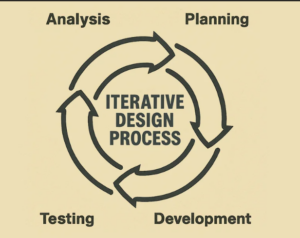
The big idea I will take with me into my future teaching practice is that the process of creating is just as important as the final product. I want my classroom to be a place where students feel comfortable taking risks, making mistakes, asking questions, collaborating, and trying again. Like the design thinking process. It is a circle. Planning =>development =>testing =>analyze. I am excited to use maker projects as part of my future Practicum.
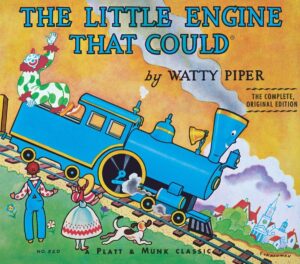
I do not want students to feel that there is only one right answer or one correct way to complete a challenge. I want them to understand that their ideas have value and that learning often comes from the process of figuring things out. This also reminds me of the book The Little Engine That Could. Its message of believing in yourself and continuing to try, even when something feels difficult, is something I want to encourage in my future classroom. Sometimes the first approach doesn’t work, and that’s okay. There is value in trying something different, asking questions, and finding your own way. To me, that’s what an inclusive makerspace should encourage.
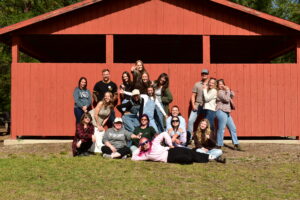
Looking back through the pictures in my montage and hearing the song I wrote, I can see more than just a collection of ADST activities. I see a collection of experiences, ideas, challenges, and opportunities to grow. I also see my cohort, who over the last four years have shared laughs and tears, triumphs and challenges alongside me. Most importantly, I am leaving this course with a better understanding of how I can bring creativity, curiosity, collaboration, and meaningful making into my own classroom. As someone who has always connected with the world through music, I want to bring that same sense of creativity and expression into my teaching. Music has taught me that there isn’t always just one way to create something beautiful, and I believe learning should be the same. I want to create a classroom where students feel comfortable taking chances, thinking outside the box, sharing their ideas, and discovering what they are capable of. Whether it is through music, building, creating, or exploring, I want my students to find their own way to make something meaningful and know that their voices and ideas matter.
There will probably be a few wrong notes along the way, but that’s part of learning. After all, you can’t make music without making a little noise!
References
Amazon.Ca: Low prices – fast shipping – millions of items. (2020). Amazon.Ca. http://www.amazon.ca
Canva. (2025). Canva. Canva.Com. http://www.canva.com
Dolly Parton’s Imagination Library. (2020, April 2). “Goodnight with Dolly” | episode 1 | Dolly Parton reads “the little engine that could” [Video]. YouTube. https://youtu.be/tT9fv_ELbnE
Kye, H. (2020). Who Is Welcome Here? A Culturally Responsive Content Analysis of Makerspace Websites. Journal of Pre-College Engineering Education Research, 10(2), 1–. https://doi.org/10.7771/2157-9288.1190
Peleg, A., & Levy, S. T. (2024). On the inter-relationships between teachers, technologies, and children in makerspace environments: A comparative case study in kindergarten classrooms. Journal of Research in Childhood Education, 38(3), 405–432. https://www.tandfonline.com/doi/full/10.1080/02568543.2023.2282662
Piper, W. (2021). The little engine that could. Golden Books.
Suno. (2025). Suno. http://www.Suno.com
Papert, S. (2000). What’s the big idea? Toward a pedagogy of idea power. IBM Systems Journal, 39(3-4), 720-729.
Welcome – design tech guide. (2025, January 6). Design TECH Guide. https://www.designtechguide.com
Woman peeking out of a box with drawings on the wall. (n.d.). [Photograph]. In Thebusinesscity.co.za. Retrieved November 10, 2026, from https://thebusinesscity.co.za/wp-content/uploads/2023/10/final-thoughts-scaled-1.jpg
