 Student Description
Julia is a Grade 2 student who demonstrates a strong interest in reading and learning. She enjoys books and spends time reading both independently and during classroom literacy activities. One of her favourite topics is animals, particularly capybaras and chipmunks. During a classroom project, she created a diorama about chipmunks, which allowed her to combine her interest in animals with hands-on learning. Julia showed strong engagement during this activity and was excited to share her knowledge with the class. Student A also demonstrates a strong ability to memorize and retain new information. Over a two-week period, she successfully learned and remembered the Ktunaxa word for chipmunk, q̓u¢a¢, using the First Voices website, which showed both her commitment to learning and her interest. She enjoys reading series rather than single books, as she likes continuing stories and familiar characters. Her favourite series is Real Friends by Shannon Hale and LeUyen Pham and is a graphic novel series that explores themes of friendship, popularity, and self-discovery through the eyes of a young girl navigating the complexities of middle school. During our conversation, Julia also shared that her favourite Disney character is Stitch, which we discovered is a shared interest. In the classroom, Julia is attentive, motivated, and eager to participate in discussions. Observations during reading activities show that she reads fluently and is able to discuss what she has read with clear understanding.
Analysis of Results
Julia was assessed using Progress Monitoring reading assessments to evaluate her reading accuracy, fluency, and comprehension through the Acadience ORF Level 2 assessment. During the assessment, Julia read three passages across two separate visits. A one-minute timer was used for each passage, and at the end of the minute, the number of words read was counted. Errors were recorded as TC (Teacher Correct), SC (Self-Correct), or by drawing a line through words read incorrectly or skipped.
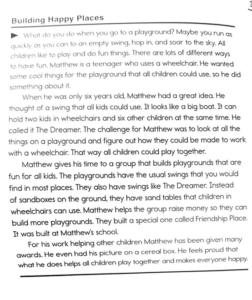 First Visit – January 13
- Building Happy Places
- Luke Makes His Move
- My Pen Pal
Second Visit – February 24
- Life on the River
- A Day for Trees
- Making Orange Juice
Building Happy Places
Julia read the passage Building Happy Places with 100 correct words out of 104 (96% accuracy). This score demonstrates strong reading accuracy and steady pacing. Julia was able to decode unfamiliar words while maintaining overall fluency, showing confidence when reading grade-level text. Julia added words to make it past tense (used the word ‘had’ before thought in the 2nd paragraph). Her comprehension was 23 words for retelling of the story providing 3 or more details, sometimes repeating the same detail as in the text. She was excited to tell me about this story.
Luke Makes His Move
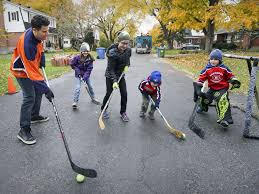 In the passage Luke Makes His Move, Julia read 91 words correctly out of 93 (97.8% accuracy). Her high accuracy indicates strong automatic word recognition and fluent reading. Julia maintained a smooth reading pace with minimal errors. She change ‘a short while’ to ‘a short walk’, and had trouble with the word ‘street’. Her comprehension was 16 for retelling, though her score was lower than the story before, she provided 3 or more details with meaningful sequence. Julia told in chronological order.
My Pen Pal
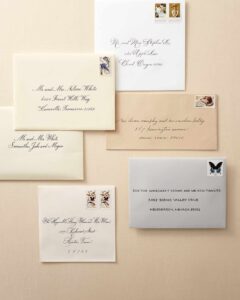 Julia read My Pen Pal with 114 correct words out of 119 (95.7% accuracy). This score reflects consistent reading fluency and strong decoding skills. She changed ‘it is’ to ‘it’s’, twice and changed the ‘I’ to ‘He’ more than once, showing that she struggled with connecting to the story in first person. Julia demonstrated the ability to read a longer passage while maintaining comprehension and accuracy. Julia’s comprehension was the lowest one in this story with a retell score of 10. She summarized and told only 2 details about the story.
A Life on the River
For A Life on the River, Julia read 103 correct words out of 105 (98% accuracy). This passage reflects one of her highest accuracy scores, demonstrating excellent word recognition and confident, fluent reading of grade-level text. The word ‘Asia’ was a challenge for her. She again used past tense in a story saying ‘gave’ instead of ‘give’. Retelling is 14 for comprehension with details of 3 or more.
A Day for Trees
Julia read A Day for Trees with 94 correct words out of 95 (95% accuracy). She maintained strong accuracy and pacing, showing effective decoding and reading fluency throughout the passage. Her words that were incorrect were ‘stream’, she said ‘streamed’, ‘cold’ was supposed to be coolness, ‘It’s’ was written as ‘Is it’, and ‘Arbor’ was a challenge sounding out, which she didn’t get. Julia’s comprehension was 13 for the retelling score providing 3 details.
Making Orange Juice
 In the passage Making Orange Juice, Julia read 121 words correctly out of 123 (98% accuracy). This high score demonstrates very strong fluency, accuracy, and automatic word recognition while reading a longer passage. Julia changed ‘sight’ into ‘seen’, and couldn’t read the word ‘pitcher’. The comprehension was 16 for the retelling and Julia retold me with details, but also adding her own experience.
Overall, Julia performed well, with scores ranging from 95.7% to 98% when reading. She was able to explain the stories clearly, demonstrating comprehension, and she provided even more detailed explanations when she personally connected with the content. On the retell scale, My Pen Pal received the lowest score of 10, while her highest score was 23 for Building Happy Places. Here is a sample of the reading
Curriculum Expectations
Assessment Source: Acadience Reading Oral Reading Fluency (ORF) – Level 2 Progress Monitoring
The Grade 2 English Language Arts curriculum in British Columbia supports students in developing skills in reading, writing, speaking, and listening to communicate meaning and understand texts. Students work with oral, written, and visual language to build literacy skills and make connections to their experiences and the world around them.
Key Grade 2 Curricular Competencies include:
- Using speaking and listening to share ideas and respond to texts.
- Reading and viewing grade-appropriate texts fluently and with understanding.
- Using reading strategies such as predicting, questioning, and making connections.
- Writing and representing ideas in sentences and short texts for a variety of purposes.
Assessment and instructional planning are supported by the BC K–4 Foundational Learning Progressions, which describe the development of early literacy skills including phonological awareness, decoding, vocabulary development, reading fluency, comprehension, and writing. These progressions help identify each student’s current level and guide next instructional steps.
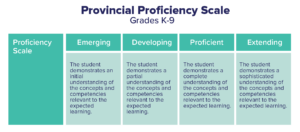
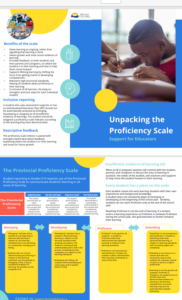
Student learning is communicated using the BC Proficiency Scale
- Emerging – initial understanding with significant support
- Developing – growing understanding with some independence
- Proficient – consistently meeting grade-level expectations
- Extending – demonstrating deeper and more sophisticated understanding
Student Focus– Julia
Based on Acadience Reading Oral Reading Fluency (ORF) Level 2 progress monitoring data, Julia demonstrates strong reading fluency and accuracy. Her ORF results place her within the 95.7%–98% performance range, indicating a high level of accuracy and automaticity when reading grade-level passages.
Julia’s performance aligns with the Proficient level on the BC Proficiency Scale. She reads grade-level texts smoothly and accurately, demonstrating strong word recognition and developing comprehension skills.
Reading Fluency:
Julia reads aloud with appropriate pace, accuracy, and expression. Her Acadience ORF progress monitoring scores indicate that she is meeting and consistently maintaining grade-level fluency benchmarks.
Comprehension:
Julia shows understanding of what she reads by identifying key ideas, making connections to her experiences, and discussing story events or information from texts.
Literacy Development:
Julia demonstrates strong foundational literacy skills consistent with the BC Foundational Learning Progressions for Grade 2, particularly in automatic word recognition and fluent reading.
Next Steps for Learning
To continue strengthening Julia’s literacy development, instruction will focus on:
- encouraging deeper comprehension discussions after reading
- exploring different text genres and more complex vocabulary
- extending written responses to reading to support critical thinking.
Overall, Julia’s Acadience ORF Level 2 progress monitoring results confirm that she is performing at a Proficient level in Grade 2 English Language Arts, demonstrating strong reading fluency and solid foundational literacy skills.
Reporting Communication
Julia is currently reading at approximately Grade 2 level and demonstrates strong comprehension skills. She reads fluently and is able to discuss what she has read, including characters, events, and important ideas in the story.
Her enthusiasm for reading, especially books about animals and series books, supports her continued literacy growth.
Classroom Literacy Setup
In an ideal Grade 2 classroom, literacy learning occurs throughout the day in different formats to support a variety of learning styles and over several subjects.
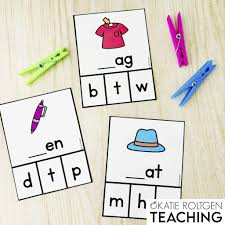 Whole-Class Literacy Activities
- Read-alouds and shared reading
- Mini-lessons on reading strategies
- Story analysis and comprehension discussions
Small-Group Activities
- Guided reading groups
- Teacher-supported comprehension practice
Independent Literacy
- Daily independent reading time
- Reading response journals
- Choice-based book exploration
- Literacy Stations
Weekly Literacy Activities
- Literacy centres (word work, writing, reading)
- Partner reading
- Story retelling activities
- Creative literacy projects (such as dioramas or story art)
Monthly Activities
- Book sharing presentations
- Author studies
Indigenous Activities
- Sharing Indigenous Stories and Picture Books that reflect Indigenous cultures, values, and teachings.
- Storytelling Circles, where students listen, reflect, and share ideas in a respectful community setting.
- Connecting Literacy to the Land, such as reading and writing about local animals, seasons, and environments.
- Inviting Indigenous Knowledge into Projects, for example learning traditional knowledge about animals like chipmunks or discussing how animals are important in Indigenous stories.
Book Recommendations
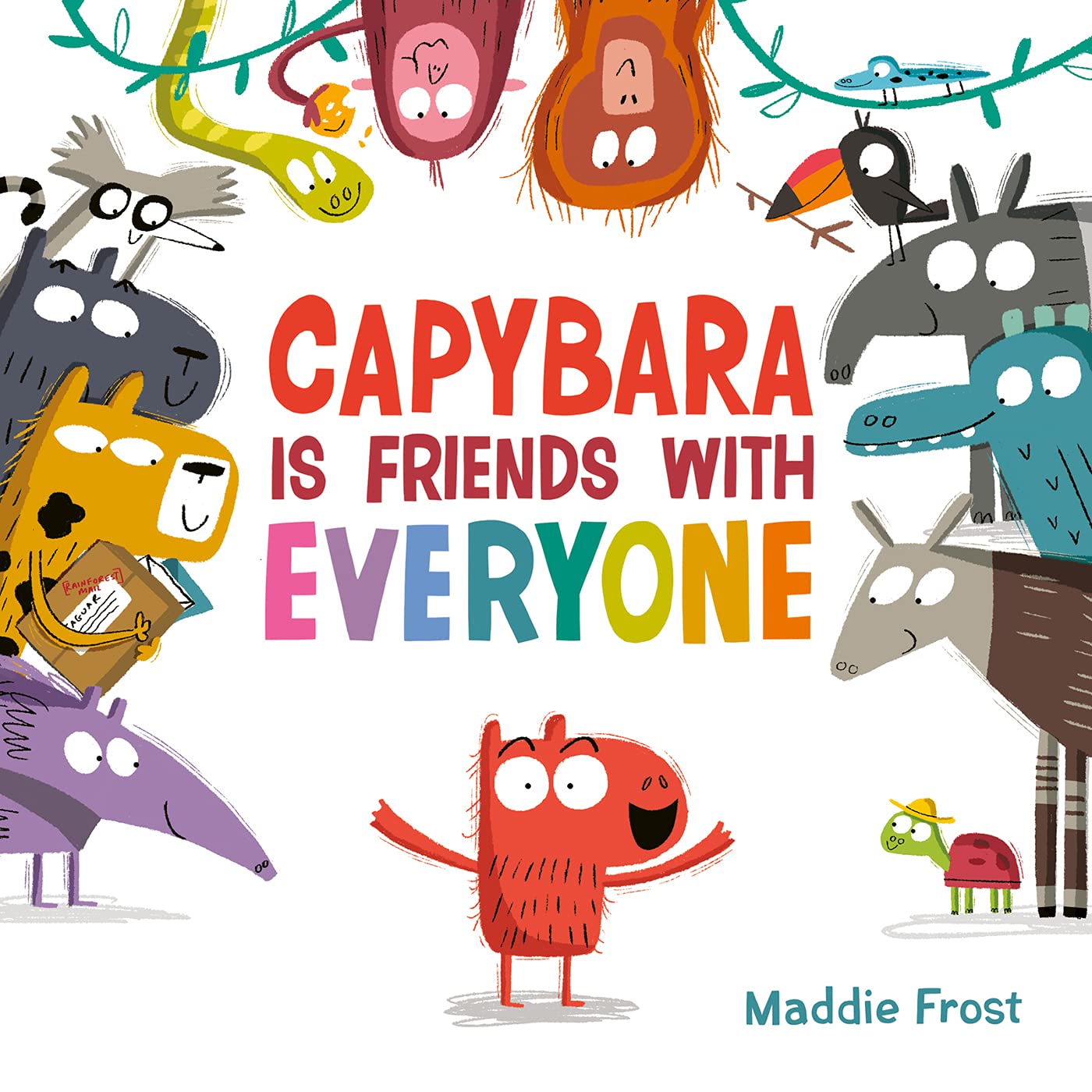
1.Capybara Is Friends with Everyone by Maddie Frost
This book is recommended for Julia because it combines humour and heart with important lessons about friendship and boundaries. Given Julia’s strong comprehension skills and her ability to explain stories in detail especially when she connects personally with the content, this book will encourage her to relate to the characters and reflect on social-emotional themes, strengthening both understanding and personal connection to the story.
2.Donut Feed the Squirrels by Mika Song
I would choose Donut Feed the Squirrels for Julia because it is a fun and engaging graphic novel that fits well with her interests. Since her favorite book series is Real Friends by Shannon Hale, which focuses on friendship and relatable characters, this book offers a similar appeal with humour.
 The graphic format makes the story easy to follow and supports her comprehension, while the illustrations keep her engaged. She likes looking at the pictures as well in a story. Julia has shown that she can explain stories clearly and connect personally with the content, so this book gives her a chance to practice retelling, understanding characters, and making connections in a way that is enjoyable and motivating. It’s also a good way to encourage independent reading, build confidence, and continue developing her fluency and comprehension skills while exploring new stories.
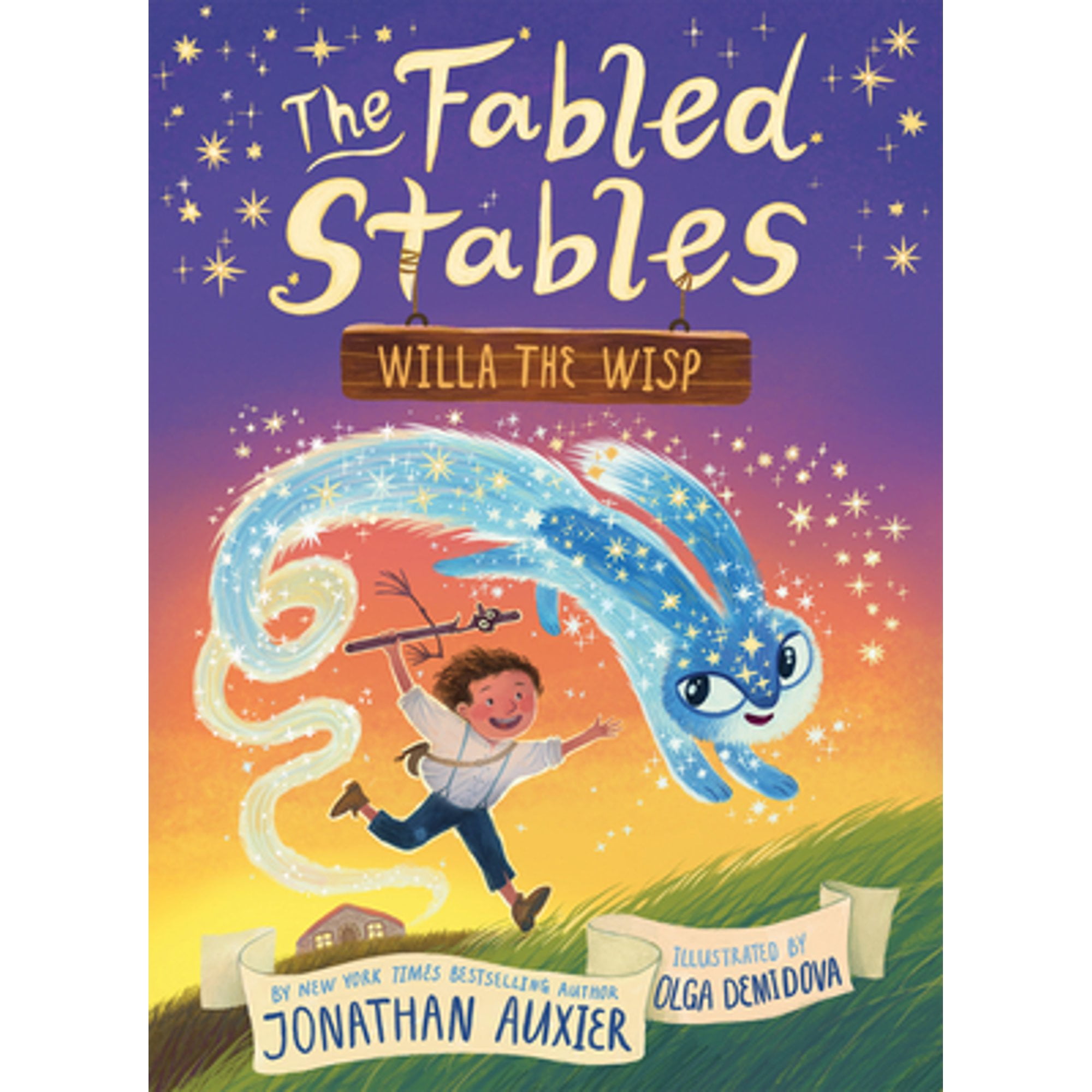
3.The Fabled Stables: Willa the Wisp by Jonathan Auxier
I would choose The Fabled Stables: Willa the Wisp for Julia because it features magical creatures and adventure, which fits well with her interests. Since her favorite Disney character is Stitch, who is an alien. She is naturally drawn to stories with unique, fantastical characters.
This book allows Julia to engage with imaginative storytelling while practicing comprehension and retelling skills. The illustrations add visual support that helps her follow the story and connect with the characters. Reading about magical creatures and their adventures will motivate her to explore new stories and strengthen her ability to make sense of plot and character development.
Classroom Supports & Small Group Instruction
Mystery Word Bags
Students reach into a bag and pull out a word on a card. They must read it aloud and use it in a sentence. This activity helps students practice decoding, pronunciation, and context clues while encouraging creative thinking. Words can range from sight words to phonics patterns, supporting both fluency and comprehension.
Illustrate the Story
After reading a short passage, students draw a scene or character from the text and label it with key words or sentences. This activity reinforces comprehension, vocabulary, and text-to-picture connections, while also allowing creative expression.
Character Interviews
Students choose a character from a story and write or role-play an interview with that character. Students can write a script and act out with a partner as an interviewer and interviewee. This builds comprehension, encourages text-based inference, and helps students explore character motivation and personality traits. It is also a fun way to learn.
Instruction
Echo Reading with Emotion
The teacher reads a short passage aloud with expression, and students repeat it back, matching tone and intonation. This activity builds fluency, expression, and engagement with the text. This can also be done in a drama game. Whisper, normal voice, yell, but with expression.
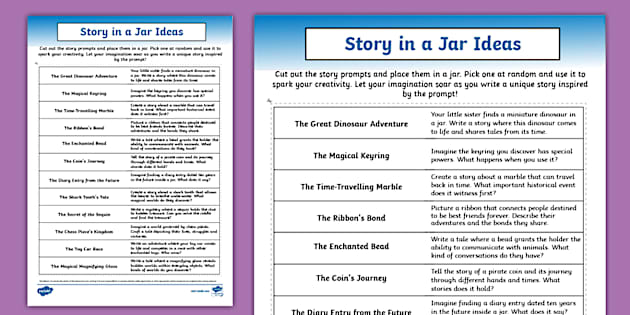
Students pick a jar with prompts (e.g., “Character,” “Problem,” “Solution”) and use the cards to retell the story in their own words. This encourages oral language, comprehension, and sequencing skills in a fun, interactive way.
Mini Novel Discussion
During class novel studies, students participate in small-group discussions about plot, characters, and their personal connections to the story. A journal would be an activity to accompany this.
Learning Services & School Supports
This platform offers animated, read-aloud versions of books with highlighting of words as they are read. It builds fluency, supports visual tracking, and allows students to explore books independently or at home.
Starfall provides interactive games, stories, and phonics activities. Students can practice decoding, sight words, and reading comprehension through guided lessons and gamified tasks.
Learning Services Teacher (LST)
The LST can implement individualized interventions, track progress, and provide targeted support for reading skills and comprehension.
Education Assistants (EAs)
EAs can provide one-on-one or small group support, breaking tasks into manageable steps, reinforcing lessons, and helping students practice new skills at their own pace.
Resource Lending & Literacy Kits
The District Resource Centre offers a wide variety of literacy kits and resources that teachers can borrow to support reading and writing instruction in the classroom. These include tools for guided reading, novel studies, hands‑on literacy activities, and other materials that help build foundational skills and comprehension strategies.
 Reference & Teacher Support Materials
Teachers can access professional reference resources, digital classroom tools, and educator materials that help with planning effective literacy lessons and interventions. This support helps educators deliver targeted instruction that meets varied student needs.
Equipment & Manipulatives for Literacy Activities
In addition to books, the DRC provides literacy‑related equipment and manipulatives that can be used for interactive and multi‑sensory reading activities. These resources allow students to engage with literacy concepts in different ways, supporting diverse learning styles.
Home Supports
Families play an important role in supporting literacy development. The following strategies can help support Julia at home:
- Daily reading routines (10–20 minutes of reading together)
- Talking about books and asking questions about the story
- Visiting the local library to find books about animals or favourite series
- Playing word games such as rhyming or word matching
Family Reading Nights
Encourage students and families to read together regularly. Parents/Caregivers or siblings can take turns reading aloud, fostering both fluency and enjoyment of reading.
Literacy Games
Play word-based games like “Alphabet Game”,“Word Bingo”,”Boggle,Jr”, “Rhyme Time,” or “Letter Scavenger Hunt” to make reading and spelling fun, interactive, and meaningful amongst family and friends.
Ongoing Assessments
Reading development will continue to be monitored throughout the school year using several assessment strategies:
- Progress Monitoring assessments
- Comprehension questions and worksheets
- Student reading responses
- Monthly Fluency Checks- Students read passages aloud while the teacher records words per minute, errors, and self-corrections. This monitors growth in fluency and accuracy over time.
- Sight Word & Phonics Checks- Students practice both sight words and nonsense words to evaluate decoding skills and fluency. Regular practice helps determine whether they are reading automatically or using phonics strategies.
These assessments will be conducted regularly to track growth and guide instruction.
References
Bright, R. (2021). Sometimes Reading Is Hard. Pembroke Publishers.
Building Student Success – B.C. Curriculum. (n.d.). Curriculum.gov.bc.ca. https://curriculum.gov.bc.ca/curriculum/english-language-arts/2/core
Frost, M. (2022). Capybara Is Friends with Everyone. HarperCollins.
Gear, A. (2024). Powerful Thinking. Pembroke Publishers Limited.
http://facebook.com/imaginationsoup. (2023, November 5). 45 Best 2nd Grade Books in a Series – Imagination Soup. Imagination Soup. https://imaginationsoup.net/chapter-book-series-2nd-graders/
K-4 Foundational English Language Arts Learning Progressions INFORMATION FOR EDUCATORS AND SCHOOL LEADERS WHAT DOES ELA LEARNING LOOK LIKE IN THE CLASSROOM? •. (n.d.). https://curriculum.gov.bc.ca/sites/curriculum.gov.bc.ca/files/pdf/learning-pathways/k-4-ela -foundational-learning-progressions.pdf
Ness, M. (2023). Read Alouds for All Learners. Solution Tree Press.
Real Friends Series by Shannon Hale. (2017). Goodreads.com. https://www.goodreads.com/series/258890-real-friends
Starfall Education. (2019). Starfall: Learn to read with phonics, learn mathematics. Starfall.com. https://www.starfall.com/h/
Tumblebooks – Read Watch Learn! (2019). Tumblebooks.com. https://www.tumblebooks.com/