As I begin my practicum as a teacher candidate, I have been thinking deeply about how to make learning meaningful, engaging, and culturally responsive for students. One theme that continues to emerge across educational resources is the power of storytelling. Storytelling is not only a tool for literacy but also a powerful way to teach science, identity, and relationships to the land. Through exploring Indigenous storytelling approaches, creative science teaching strategies, and the First Peoples Principles of Learning, I am beginning to see how stories can become the foundation of a holistic classroom.
 Indigenous storytelling has long been a method of passing knowledge, values, and history from one generation to the next. Oral traditions are central to many Indigenous cultures and serve as a way to teach cultural teachings, community values, and relationships with the world around us. Through stories, knowledge is shared in a relational and meaningful way that connects learners to their culture, history, and identity.
One example that resonated with me was the idea of story vines, a creative approach used in my insitus where we braided fabric strands together and attach artifacts that represent parts of a story. These items serve as prompts for oral storytelling and help learners retell creation stories or personal narratives. Story vines demonstrate how art, storytelling, and learning can intertwine in the classroom while supporting multiple subjects and grade levels. This can be used in science as well.
This would strongly connect to the BC Grade 5 Science curriculum, particularly the Big Idea that living things and systems interact within their environment and that humans have a responsibility to care for the natural world. Storytelling, including story vines, supports students in understanding these relationships by allowing them to represent connections between living things, land, and systems in a meaningful way. It also aligns with curricular competencies such as demonstrating curiosity, asking questions, and communicating ideas in a variety of ways. By incorporating Indigenous storytelling approaches, students are also engaging with First Peoples perspectives, which emphasize interconnectedness, place-based learning, and learning through story
 Storytelling can be a tool in science education. In the article Dragons and Fairy Tales in Science Class, shows that students are often far more engaged when scientific concepts are introduced through stories. For example, one teacher used a fictional story about dragons to introduce concepts about evolution and animal structures. Students became curious about how dragons might survive in different environments, which then led them to explore real biological concepts such as adaptation and homologous structures.
AH Ha Moment
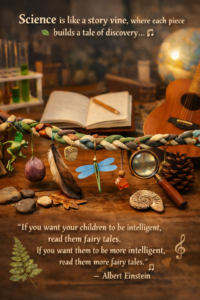 Stories engage the brain in a different way than traditional lectures because they help students connect emotionally and mentally to what they are learning. While thinking about this and learning about story vines, I had a bit of an ah-ha moment. Story vines allow stories to be told through objects, art, and oral storytelling, but they can also be a powerful way to explore science. For example, students could add different objects to a vine that represent parts of a scientific process, relationships in nature, or connections between living things and the land. Instead of simply memorizing facts, students are building and telling the story of the science themselves.
It also made me think about music. Just like music has rhythm and meaning that connect people to emotions and experiences, storytelling through something like a story vine creates a rhythm to learning. Each object or piece added becomes another “note” in the story. When students share and retell those stories, the science becomes something they understand and feel connected to, rather than something they just read in a textbook
I find this especially meaningful as I prepare for my practicum because it aligns with the kind of classroom environment I hope to create. I want students to feel curious and engaged, rather than passive. Using storytelling can help students see themselves in the learning process and recognize that knowledge comes from many sources, including culture, experience, and community. This might look like integrating story vines into a lesson where students create visual prompts to retell a story about their identity, their community, or the natural world. Beginning a science lesson with a narrative that sparks curiosity before moving into investigation and inquiry connects to First Peoples Principles of Learning and the Science First Peoples Teacher Resource Guide for Grades 5-9. These approaches allow students to use creativity, culture, and imagination alongside academic learning.
As Albert Einstein once said, “If you want your children to be intelligent, read them fairy tales. If you want them to be more intelligent, read them more fairy tales.” Through storytelling approaches like story vines, science learning can become something students not only understand, but also feel connected to.
Resources
Oral Storytelling with Story Vines: An Indigenous Perspective | ArtsJunktion website
www.chatgpt.com Image
How to Use Storytelling to Boost Learning in Science Class | Edutopia
Full article: Using storytelling to teach a topic in physics
First Peoples Principles of Learning – First Nations Education Steering Committee FNESC