Learning about provocations and inquiry-based learning has inspired me to think differently about how I want my future classroom to look and feel. These approaches connect strongly to Teacher Competency 10, which focuses on using reflective practice and evidence-informed approaches to improve teaching and learning. When teachers design meaningful learning experiences and then reflect on how students engage with them, they are actively growing in their practice and responding to students’ needs in real time.
Educational philosophers who support these ideas include Maria Montessori, who believed deeply in hands-on, self-directed learning and the importance of a prepared environment. While Montessori did not use the word “provocations,” her philosophy aligns closely with this approach because she believed the environment and materials should invite curiosity, independence, and exploration. Provocations feel like a modern extension of this idea intentionally setting up experiences and materials that spark thinking, wondering, and deeper engagement.
What I love about this approach:
-
Encourages curiosity and exploration
-
Lets kids be creative and express themselves
-
Puts the child at the center of their own learning
-
Uses the environment
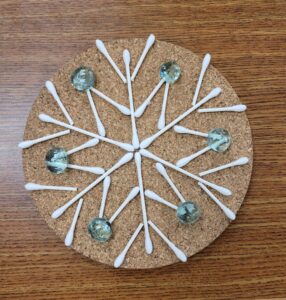 In one of our class, our instructor set up materials and asked, “How can you build a snowflake?” It was amazing to see how each of us interpreted that differently. Some followed the papers that were given out that had patterns, and others, like myself, made their own. Then, we went further with inquiry-based questions like, “What would you change? What else could you have used?” It really made me realize how powerful it is when students are given the chance to explore and question for themselves.
This approach values the process over the final product. It pushes students to think critically, solve problems, and stay curious without being boxed into one right answer. As a future teacher, this connects back to Competency 10 of the Teacher Education Competencies from the University of Victoria, because it reminds me that I need to constantly reflect on how my teaching choices impact student learning, and be willing to adapt my practice to better support their thinking and growth.
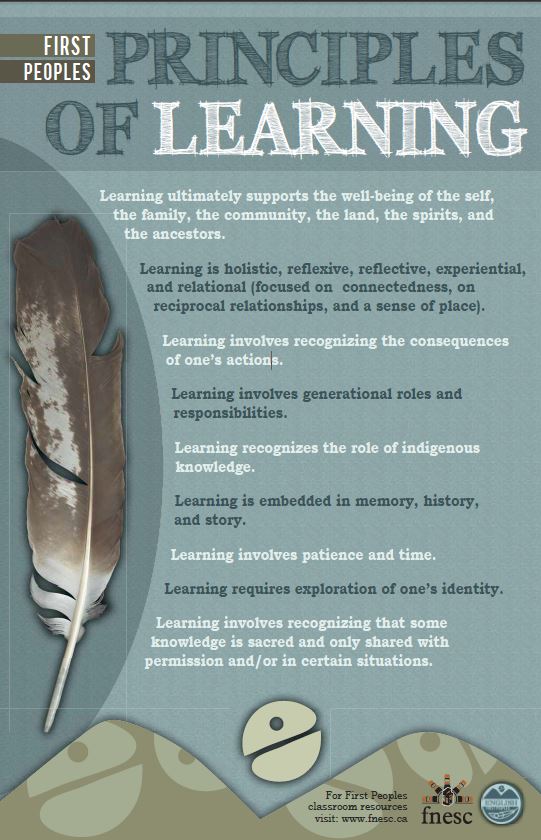
This activity ties with the First Peoples Principles of Learning. Inquiry-based learning reflects the idea that education is holistic, personal, and connected to yourself, each other, and the land. Learning is most meaningful when it’s authentic and relevant, and inquiry gives kids that opportunity.
I want to make sure my classroom is one where students can wonder, create, and problem-solve. Provocations and inquiry-based learning aren’t just teaching strategies, they’re ways to help kids develop skills they’ll carry for life. I think it’s a way to help them fall in love with learning, which, to me, is one of the most important goals a teacher can have.
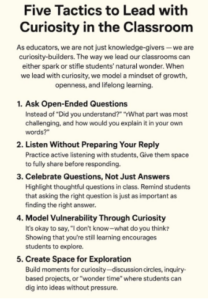 I also read an article by Dr. Hana Rabbouch called “How to Lead with Curiosity in the Classroom,” which really deepened my thinking about why curiosity should be at the heart of teaching. In it, Dr. Rabbouch explains that teachers aren’t just sources of information, they are builders of curiosity who create environments where students feel safe to wonder, ask questions, and explore ideas deeply. She suggests practical ways teachers can model curiosity, like asking open-ended questions, listening fully before replying, celebrating student questions, and creating space for exploration. This directly connects to my experience with provocations and inquiry learning; both perspectives emphasize that encouraging students to think for themselves not only enriches their learning in the moment, but also helps them become lifelong learners who are confident and engaged.
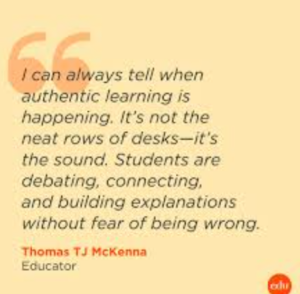
Two points that you made resonated with me and I appreciate these ideas:
1) “This approach values the process over the final product.’ – pertaining to inquiry and how a final product is not always the learning piece’ and the words of Dr. Hana Rabbouch who states that 2) ‘teachers aren’t just sources of information, they are builders of curiosity who create environments where students feel safe to wonder, ask questions, and explore ideas deeply.’
Stay curious yourself and this will weave itself into your teaching!
Judi