When I first heard about Story Vines as a literacy strategy in Sometimes Reading Is Hard by Robin Bright, I wasn’t quite sure what to expect. The idea sounded creative, but I didn’t yet understand how powerful it could be for helping students retell and understand stories deeply. In Bright’s textbook, Story Vines helps students build vocabulary, story comprehension, sequencing skills, and oral language through visual and tactile representations of text.
What is a Story Vine?
A Story Vine is a braided piece of material usually yarn or rope with objects, symbols, or visuals attached in the order that events occur in a story. If you have students that struggle with fine motor skills, you can have premade yarn or yarn that looks braided, to give to them. These objects on the braided rope act as prompts during an oral retelling, helping students recall and share key points. Story Vines are not about memorizing exact words, but about summarizing and communicating story meaning in sequence.
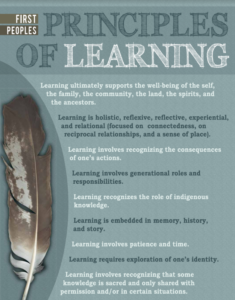 First Peoples Principles of Learning:
-
Story Vines reflect the First Peoples Principle that learning is holistic, experiential, and relational, as students use their hands, voices, and connections with others to make meaning from story.
- This activity supports the understanding that learning is embedded in memory, history, and story, as oral retelling honours Indigenous storytelling traditions and values knowledge passed down through generations.
- The collaboration of creating and sharing Story Vines reflects the principle that learning involves generational roles and responsibilities, as students listen respectfully and take turns holding and sharing the story.
Insitu Story Vine
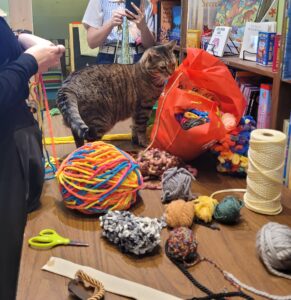 Before our students began, I created my own Story Vine based on The Paper Bag Princess by Robert Munsch. The story has a clear beginning, middle, and end with different characters and events that lend themselves to visual representation on a vertical vine.
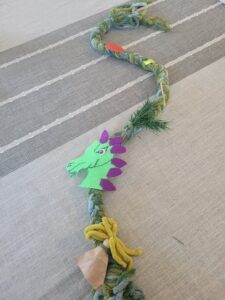 I braided yard and added objects, such as:
- wooden figurine with hair and a paper bag dress representing Elizabeth
- Dragon
- crown to represent the Prince Ronald
- Trees representing the forest
- a match to represent the fire breathed by the dragon
- heart to represent the ending
I had the braided yard as a model to show the students in the Insitu. Each item helped me map the story so I could retell it. It started from the bottom and made it’s way up.
An article
The article My Story Vine, Share stories through oral tradition, describes how Story Vines were used as a learning experience to help students share personal stories and build oral language skills. It explains that students learned about the importance of oral storytelling, especially in Indigenous cultures, and created their own Story Vines using materials that represented parts of their lives or chosen stories. Students used their vines as prompts to share stories in a circle, practiced listening, and then displayed their vines in the classroom or hallways. The activity supported students in connecting with themselves and others, strengthening communication and listening skills while engaging with narrative and identity. This is something I will be taking with me to my practicum for a Language Arts Unit I am doing.
Story Vines connect directly to many ELA curricular competencies and content expectations in both Grade 2 and Grade 3:
Curricular Competencies
-
Explore oral storytelling processes
-
Recognize the structure and elements of story
-
Use sources of information and prior knowledge to make meaning
-
Use developmentally appropriate reading, listening, and viewing strategies to make meaning
Creating and presenting Story Vines requires students to comprehend text, plan, organize, and communicate orally, exactly as the curriculum outlines. By choosing symbols and retelling stories, students practice both comprehension strategies and expressive language skills.
Big Ideas Across Both Grades
-
Language and story can be a source of creativity and joy.
Connection
One of the most rewarding parts was seeing the Grade 2/3 students share their Story Vines with kindergarten learners. Students stood up, held their vines, and retold their stories with confidence. They adapted their language for younger listeners and answered questions about their symbols. According to Sometimes Reading Is Hard textbook, Story Vines help students make connections between visual representations and narrative structure, encouraging comprehension through creation and performance not just decoding words on a page.
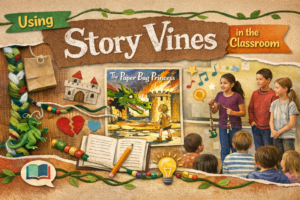 Story Vines are more than an art project, they support reading comprehension, oral communication, and narrative understanding. Through making and sharing Story Vines based on The Paper Bag Princess and other texts, student can learn to revisit a story, think critically about its parts, and express it creatively. When they shared with kindergarten students, it deepened their understanding and strengthened their confidence. This strategy aligns beautifully with the ELA curriculum in both Grade 2 and Grade 3, offering students a hands-on way to engage with texts and with each other through creativity and joy. A Story Vine can be used in several different subjects to help with hands on learning.
Resources
Chatgpt.com. Image