Magic E
Literacy Station- Snakes & Ladders- Magic E
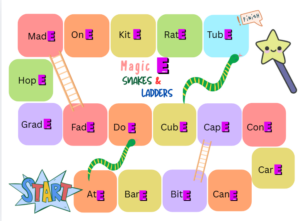 For our literacy stations, I had the opportunity to design and run a literacy station focused on Magic E (also known as the silent “e”) for a Grade 1 class. This station was part of a rotation of literacy centers, where small groups of students moved through different hands-on activities to practice reading and phonics skills. For my station, I created a Snakes and Ladders board game where every square contained a Magic E word (e.g., cap – cape, tap – tape, hop – hope). They worked independently for this and took turns going around the table, each rolling the dice and taking their turn on their board.
After the Snakes & Ladders activity, I had a list of Magic E words that I gave each pair of students. They had a die, and worked together to see which team could get the furthest before the time ran out and had to move to the next table. The goal wasn’t just to win, but to cooperate, take turns, support each other with decoding, and practice reading Magic E words accurately. If I had of had internet at the school where we were, I would have shown this video on Magic E, as the beginning of my station and then asked the questions about what Magic E is.
BC English Language Arts Grade 1
Big Idea
-
Language and text can be a source of creativity and joy.
Curricular Competencies
-
Use phonics and word analysis strategies to decode words
-
Read fluently at the appropriate level
-
Collaborate with others to share ideas and support learning
-
Engage in literacy tasks through play and interaction
Content
-
Phonics and decoding strategies (including vowel patterns and word families)
-
Reading strategies and oral language development
-
Development of early reading skills through play-based learning
Reflection and Professional Standards for BC Educators
Through this activity, I learned the importance of:
-
Designing play-based, hands-on learning that meets diverse learning needs
-
Creating a supportive environment where students feel safe to try, make mistakes, and learn together
-
Encouraging cooperation rather than competition, which helped reduce pressure and increase confidence
 Students naturally encouraged each other reminded me that literacy development is not just about individual skill-building, but also about fostering community and connection in the classroom. this experience reinforced the value of using interactive literacy stations to support early reading development while building positive classroom relationships. The station felt playful and low-pressure, which helped students who were less confident readers take risks. Many students naturally supported one another by sounding out words together or celebrating when their partner successfully decoded a tricky word.
This literacy station showed me how important play-based learning can be for building early reading skills. I noticed that when learning felt like a game, students were more willing to take risks with sounding out Magic E words and were more supportive of each other. The cooperative structure helped reduce pressure and encouraged positive peer interaction, which made the station feel welcoming for all learners.
This helped me grow in confidence as an educator. I learned how important clear instructions, modelling, and gentle support are, especially in primary classrooms where students are still developing independence. Small design choices, like having students work in teams instead of individually, made a big difference in engagement and comfort. They enjoyed both games and built on their words.
In my future classroom, I would love to build on this by connecting music and literacy. For example, students could sing Magic E patterns, clap syllables, or move to rhythms while reading the word. Pairing phonics with music and movement would support different learning styles and make literacy practice more memorable, joyful, and accessible. I am constantly trying to find ways to bring music into my activities. I found a song called “The Magic E Song” on Spotify by Kids TV 123, that would be fun to learn and then teach students.
Resources
Pinterest.com
Canva.com