Finding Science in my Lunch Kit
 If someone told me that eating bananas had anything to do with X-rays or airport security, I would’ve assumed they were joking. But science is weird in the best way and bananas are a perfect example of how everyday foods can connect to much bigger ideas. I learned that this week in science class from our guest speaker.
Bananas are famous for being high in potassium. Potassium is an important element for our bodies. It helps our muscles move, our nerves send signals, and our hearts beat properly. Without enough potassium, people can feel weak, crampy, or tired. So when we’re told “eat a banana,” it’s not just random advice, it’s actually good science-backed nutrition.
Here’s where it gets interesting, potassium comes in different forms, and one of them, potassium-40, is naturally radioactive. That sounds scary at first, but it’s totally normal and harmless in the amounts we consume. Our bodies are already slightly radioactive because potassium is part of our natural biology. Eating a banana doesn’t turn you into a superhero or give you X-ray vision but it does mean bananas give off tiny, tiny amounts of radiation.
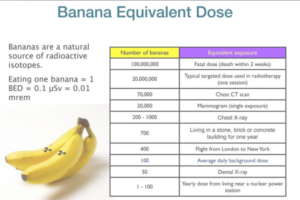
This is where the famous comparison comes in: about 50 bananas contain roughly the same amount of radiation as a single dental X-ray. That sounds dramatic, but it actually shows how safe everyday radiation exposure is when it’s in tiny amounts. You’d have to eat an unreasonable number of bananas at once for it to matter (and your stomach would quit long before radiation ever became the issue).
A large shipment of bananas can sometimes set off radiation detectors at airports or border crossings. Not because bananas are dangerous but because the potassium-40 inside them is detectable by sensitive equipment. Imagine explaining to security that the “suspicious material” is just… fruit.
 Learning stuff like this makes me realize how powerful curiosity can be. As a teacher candidate, I don’t just want students to memorize facts like “bananas have potassium.” I want them to notice the weird, interesting connections in the world. Food connects to chemistry. Chemistry connects to physics. Physics connects to the technology we use every day, like X-ray machines and airport scanners. Science isn’t just in textbooks, it’s in lunch boxes and grocery stores.
Potassium itself is a great example of how one tiny thing can matter in huge ways. It’s not just in bananas, it’s in lots of foods like potatoes, beans, leafy greens, and sunflower seeds. In the body, potassium works with sodium to control fluid balance and nerve signals. It helps muscles contract, including your heart muscle. That means something as simple as what we eat can affect how our entire body functions.
As a future teacher, I’m learning that my job isn’t to make science feel big and intimidating, it’s to make it feel close and familiar. To make that connection for my students. When students realize that the food they eat, the sounds they hear, and the places they go are all connected to real science, learning becomes less about memorizing and more about wondering.
Resources
Bing.com, 2026, th.bing.com/th/id/OIP.pstqtq9hhUIWLQ2QsML9SgHaJ4?w=118&h=180&c=7&r=0&o=7&cb=defcache2&dpr=1.5&pid=1.7&rm=3&defcache=1. Accessed 16 Feb. 2026. Image