Many Sciences & Many Stories
Before this week, I used to think of “a scientist” as one kind of person who just… knows science. Like, if you’re a scientist, you probably know about space, animals, rocks, weather, medicine, and everything in between. But the more we talked about science in class and listened to our guest speaker, the more I realized that science isn’t just one thing, it’s a whole bunch of different fields, and scientists are experts in their field, not in every field, which makes perfect sense.
Someone who studies stars and planets (astronomy) isn’t automatically an expert on animals or plants (biology). A person who researches earthquakes (geology) doesn’t necessarily know how the human brain works (neuroscience). Each scientist spends years learning, researching, and practicing in one specific area. That doesn’t mean they can’t be curious about other topics, it just means real expertise takes time and focus. Science is like a huge team project where everyone brings their own specialty to the table.
 As a teacher candidate, this was actually really reassuring to think about. It reminded me that teachers don’t have to know everything either. We’re not meant to be walking encyclopedias. Instead, our role is to be curious learners alongside our students and to model how to ask good questions, how to research, and how to admit when we don’t know something YET. Just like scientists rely on each other, teachers rely on resources, colleagues, and even students’ ideas to build understanding together.
This idea of different fields of knowledge, also connects in a cool way to mythology. Long before people had scientific explanations for natural events like thunder, lightning, earthquakes, or storms, cultures explained them through stories and gods. In Greek mythology, thunder and lightning were linked to Zeus, the king of the gods. In Japanese mythology, thunder and storms are connected to Raijin. These stories helped people make sense of powerful and sometimes scary natural events in ways that felt meaningful.
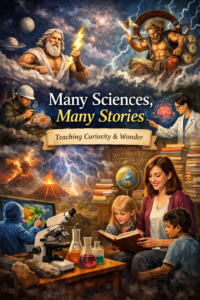 Today, instead of saying thunder comes from a god, meteorologists study storms, pressure systems, and how lightning forms. Seismologists study earthquakes. Physicists study electricity and energy. Science gives us explanations based on evidence and testing. But mythology still matters because it gives us culture, stories, creativity, and different ways of seeing the world.
As a future teacher, I love the idea that science and storytelling can live side by side in the classroom. We can explore the scientific explanation for thunder and then also look at how different cultures, like ancient Greece and Japan, explained the same phenomenon through mythology. This helps students see that science is part of a much bigger story. It also opens the door for cross-curricular learning mixing science with literacy, Indigenous studies, social studies, art, and even music!
Most importantly, this reminds me that learning is never finished, for students or teachers. Just like scientists keep learning within and beyond their fields, teachers keep growing, asking questions, and discovering new ways to understand the world with their students. We are life-long learners.
Science gives us the “how.”
Mythology gives us the story.
Teaching is about helping students hold space for both curiosity and understanding, as they make sense of the world around them. It is the See, Thinking, Wonder.
Resources
Chatgpt. “ChatGPT .” Chatgpt.com, www.chatgpt.com. Image
Chapterly.com, 2026, www.chapterly.com/_next/image?url=%2Fimages%2Fname-generator%2Fgreek-gods.png&w=1920&q=75. Accessed 16 Feb. 2026. Image cover
Etsy. Etsystatic.com, 2026, i.etsystatic.com/26815807/r/il/a99e94/3138346907/il_1080xN.3138346907_263v.jpg. Accessed 16 Feb. 2026. Image
Mybib. “MyBib Bibliography Generator.” MyBib.com, 13 July 2018, www.mybib.com.