One of the coolest experiences I’ve had this semester as a teacher candidate was creating our own driftwood “creatures” in class. We were given pieces of driftwood and asked to turn them into a creature with both a creative name and a scientific-sounding name, then build a background story about how we came upon it. It felt a little silly at first, but once I got into it, I realized how powerful this kind of activity actually is. My creature was named Octiogopogo, and I imagined discovering deep in the ocean in the depths, tangled in seaweed like it had traveled a long way to be found.
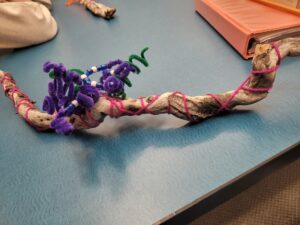 As I worked on my creature, I noticed how naturally the learning started to blend together. There was art in shaping and decorating the driftwood, science in thinking about habitats and characteristics, and literacy in creating a story and name that gave my creature a life of its own. It didn’t feel like “doing an assignment”, it felt like exploring, imagining, and making meaning. I also noticed how engaged everyone in the room was. People were laughing, sharing ideas, asking each other questions, and genuinely invested in what they were creating. That kind of energy is something I really hope to bring into my future classroom.
This experience made me think a lot about how learning doesn’t have to be separated into neat little subject boxes. A project like this could easily be adapted for an elementary classroom by connecting science (habitats, animals, ecosystems), art (sculpting, design, found materials), and ELA (storytelling, descriptive writing, presentations). Very cross-curricular. Students could discover their creatures, give them scientific names, describe where they live, what they eat, and even what role they play in an ecosystem. Suddenly, students are learning big concepts through creativity and play and they don’t even realize how much learning they’re doing because they’re having fun.
If I were to do this with my own class one day, I’d love to turn it into a mini inquiry project. We could start with a mysterious piece of driftwood and ask, “What could this be?” From there, students could design their own creatures, research real animals for inspiration, and write stories about how they discovered them. This kind of learning invites curiosity, imagination, and ownership, which are all things I want students to feel in my classroom.
This project reminded me that learning can be playful and meaningful at the same time. It also reminded me why I want to be a teacher in the first place. I want to create spaces where kids feel excited to explore, create, and tell stories about the world around them, even if that world includes a driftwood creature named Octiogopogo.